I have posted a new preprint, “Unit Liars in a Cubic Frobenius Test: An Exact Formula and an $N^{-3/2}$ Semiprime Bound” (v0.3.1), together with its companion note, “Which Root Does Frobenius Pick? An explicit rule for $x^3-qx-q$, proved from scratch”.
The setting is the cubic probable-prime test built on $f(X)=X^3-qX-q$, with $q$ prime and $4q-27$ a perfect square. For such $q$ the algebra $(\mathbb{Z}/N\mathbb{Z})[X]/(f)$ carries two nonidentity automorphisms, and a single modular exponentiation modulo $q$ selects the one that plays the role of Frobenius. A unit liar is a unit $z$ that passes the test even though $N$ is composite: $z^N$ equals the selected conjugate of $z$.
The main result is that liars can be counted exactly. For every squarefree $N$, the liar proportion $\rho$ factors as an explicit product with one elementary gcd factor per prime divisor of $N$: an exact formula, proved from the Chinese remainder theorem and cyclic-group kernel counts.
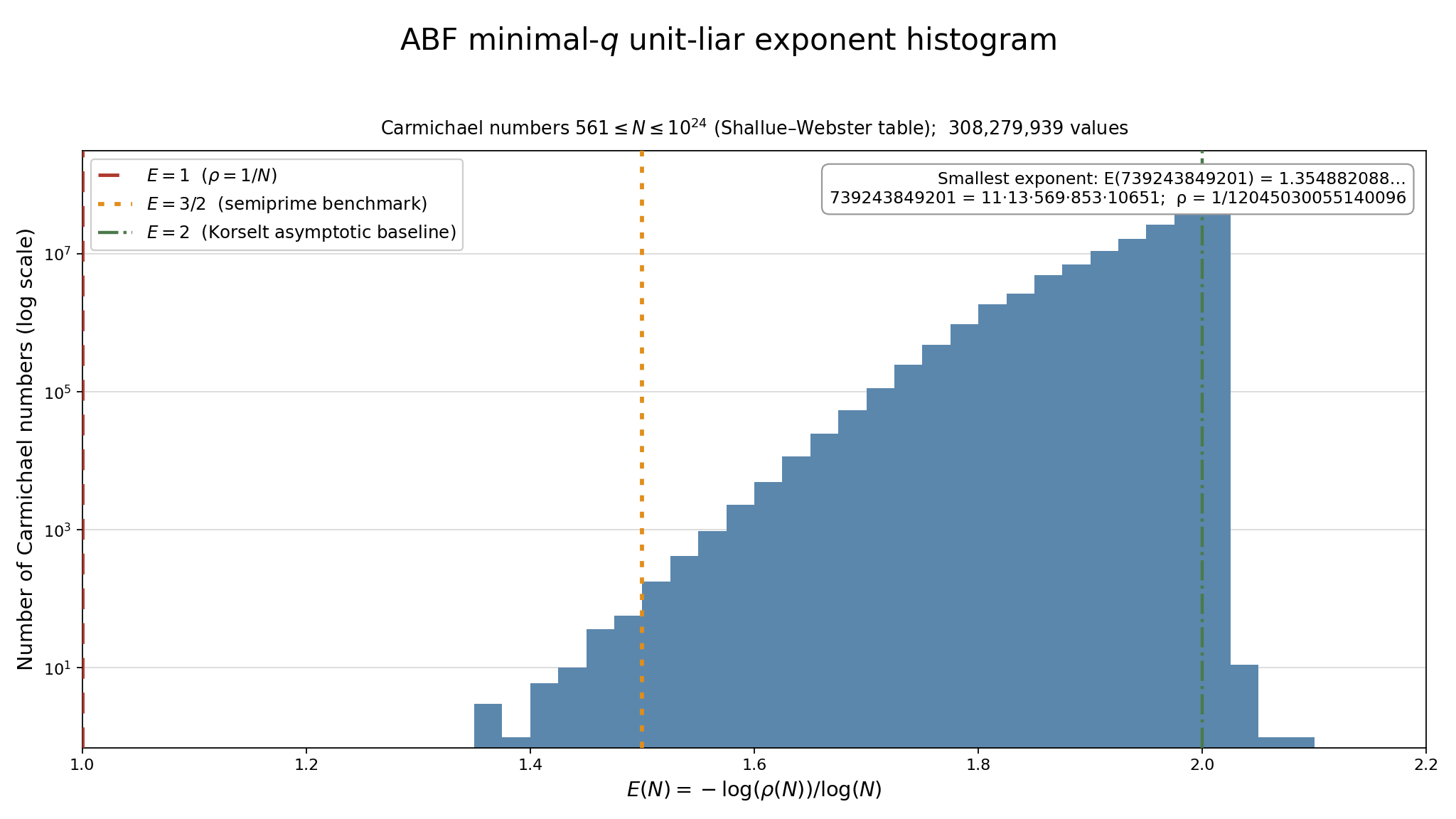
Its principal application: if $N=pr$ is a product of two distinct odd primes, then $\rho<N^{-3/2}$, uniformly over every admissible $q$. The exponent is conditionally sharp. Along the boundary family $r=p^3+p-1$, $\rho N^{3/2}$ approaches $1$ from below, and the tiny instance $2443=7\mathbin{\cdot}349$ with $q=937$ already reaches $0.971482621\ldots$. A census of all $14{,}424{,}896$ semiprimes below $10^8$ found the smallest liar exponent $1.519038071\ldots$, at $N=81{,}536{,}393=113\mathbin{\cdot}721{,}561$, safely above the theoretical $3/2$ line everywhere.
The companion note proves the selection rule from scratch: the roots are identified inside the cyclic cubic subfield of $\mathbb{Q}(\zeta_q)$, and a cubic Jacobi sum decides which conjugation Frobenius induces. An appendix unpacks the cubic algebra at composite moduli from first principles.
Thanks to Fable, ChatGPT, and Kimi K3 for dialogue, review, and cross-checking. Comments welcome!

1 comment
Comments are closed.